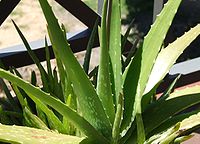
Scientific classificationKingdom:
 Plantae
(unranked): Angiosperms
(unranked): Monocots
Order: Asparagales
Family: Asphodelaceae
Genus: Aloe
Species: A. vera
Binomial name Aloe vera
(L.) Burm.f.

Aloe vera, also known as the Medicinal Aloe, is a species of
succulent plant that probably originated in northern
Africa. The species does not have any naturally occurring populations, although closely related
Aloes do occur in northern Africa.
[1] The species is frequently cited as being used in
herbal medicine since the beginning of the first century AD, because it is mentioned in the
New Testament (
John 19:39�40 And there came also Nicodemus, which at the first came to Jesus by night, and brought a mixture of myrrh and aloes... ).
[2] However, it is unclear whether the aloes described in the Bible are derived from A. vera. Extracts from A. vera are widely used in the
cosmetics and
alternative medicine industries, being marketed as variously having rejuvenating, healing or soothing properties.
[3][4][5] There is, however, little scientific evidence of the effectiveness or safety of A. vera extracts for either cosmetic or medicinal purposes, and what positive evidence is available is frequently contradicted by other studies.
[6][7][8][9] Despite these limitations, there is some preliminary evidence that A. vera extracts may be useful in the treatment of
diabetes and elevated blood lipids in humans.
[8] These positive effects are thought to be due to the presence of compounds such as
mannans,
anthraquinones and
lectins.
[8][10][11]Description A. vera are sometimes known as A. vera var. chinensis
A. vera is a stemless or very short-stemmed
succulent plant growing to 60�100 cm (24�39 in) tall, spreading by
offsets. The
leaves are
lanceolate, thick and fleshy, green to grey-green, with some varieties showing white flecks on the upper and lower leaf surfaces.
[12] The margin of the leaf is
serrated and has small white teeth. The
flowers are produced in summer on a spike up to 90 cm (35 in) tall, each flower pendulous, with a yellow tubular
corolla 2�3 cm (0.8�1.2 in) long.
[12][13] Like other Aloe species, A. vera forms
arbuscular mycorrhiza, a
symbiosis that allows the plant better access to mineral nutrients in soil.
[14]Taxonomy and etymologyThe species has a number of
synonyms: A. barbadensis Mill., Aloe indica Royle, Aloe perfoliata L. var. vera and A. vulgaris Lam.,
[15][16] and common names including Chinese Aloe, Indian Aloe, True Aloe, Barbados Aloe, Burn Aloe, First Aid Plant, Wand of Heaven and Miracle Plant.
[13][17][18][19][20] The species name vera means true or genuine.
[17] Some literature identifies the white spotted form of A. vera as A. vera var. chinensis,
[21][22] however, the species varies widely with regard to leaf spots
[1] and it has been suggested that the spotted form of A. vera may be
conspecific with A. massawana.
[23] The species was first described by
Carl Linnaeus in 1753 as Aloe perfoliata var. vera,
[24] and was described again, twice, in 1768 by
Nicolaas Laurens Burman and
Philip Miller. Burman described the species as Aloe vera in Flora Indica on the 6th of April, 1768 while Miller described the species as Aloe barbadensis some ten days later in the Gardener's Dictionary.
[25]Techniques based on
DNA comparison suggest that A. vera is relatively closely related to
Aloe perryi, a species that is endemic to
Yemen.
[26] Similar techniques, using
chloroplast DNA sequence comparison and
ISSR profiling have also suggested that A. vera is closely related to
Aloe forbesii,
Aloe inermis,
Aloe scobinifolia,
Aloe sinkatana and
Aloe striata.
[27] With the exception of South African species, A. striata, these Aloe species are native to
Socotra (
Yemen),
Somalia and
Sudan.
[27] The lack of obvious natural populations of the species have led some authors to suggest that A. vera may be of
hybrid origin.
[28]DistributionThe natural range of A. vera is unclear, as the species has been widely cultivated throughout the world. It has been suggested that naturalised stands of the species occur through North Africa in
Algeria,
Morocco, and
Tunisia, along with the
Canary and
Madeira Islands.
[15] The species was introduced to
China,
India,
Pakistan and various parts of southern Europe in the 17th century.
[29] The species is widely naturalised elsewhere, occurring in temperate and tropical regions of
Australia,
Barbados,
Belize,
Nigeria,
Paraguay and the
USA.
[1][30] It has been suggested that, like many Aloes, the species is originally from Southern Africa and that populations that occur elsewhere are the result of human cultivation.
[1]CultivationAloe vera growing as an ornamental plant
A. vera has been widely grown as an ornamental plant. The species is popular with modern gardeners as a putatively
medicinal plant and due to its interesting flowers, form and succulence. This succulence enables the species to survive in areas of low natural rainfall, making it ideal for rockeries and other low-water use gardens.
[12] The species is hardy in
zones 8�11, although it is intolerant of very heavy frost or snow.
[13][31] The species is relatively resistant to most insect pests, though
mealy bugs,
scale insects and
aphid species may cause a decline in plant health.
[32][33] In pots, the species requires well-drained sandy potting soil and bright sunny conditions. The use of a good quality commercial propagation mix or pre-packaged "cacti and succulent mixes" are recommended as they allow good drainage.
[34] Terracotta pots are preferable as they are porous.
[34] Potted plants should be allowed to completely dry prior to re-watering. During winter, A. vera may become dormant, during which little moisture is required. In areas that receive frost or snow the species is best kept indoors or in heated glasshouses.
[13] Large scale agricultural production of A. vera is undertaken in
Australia,
[35] Cuba,
[36] the
Dominican Republic,
Mexico,
[37] India,
[38] Jamaica,
[39] Kenya and
South Africa,
[40] along with the USA
[41] to supply the cosmetics industry with A. vera
gel.
Anthropogenic uses
Moisturizer containing A. vera
Scientific evidence for the cosmetic and therapeutic effectiveness of Aloe vera is limited and when present is typically contradictory.
[6][7] Despite this, the cosmetic and alternative medicine industries regularly make claims regarding the soothing, moisturising and healing properties of A. vera, especially via Internet advertising.
[3][4][5][8] As a food, A. vera is very bitter and unpalatable.
[42] A. vera gel, however, is used as an ingredient in commercially available
yogurt,
beverages and some
desserts.
[43][44][45] It is common practice for cosmetic companies to add sap or other derivatives from A. vera to products such as
makeup,
tissues,
moisturizers,
soaps,
sunscreens,
incense,
razors and
shampoos.
[43] It has also been suggested that biofuels could be obtained from A. vera seeds.
[46] Other uses for extracts of A. vera include the dilution of
semen for the artificial fertilisation of sheep,
[47] use as fresh food preservative,
[48] and use in
water conservation in small farms.[49]
MedicineAloe vera has a long association with
herbal medicine, although it is not known when its medical applications were first discovered. Early records of A. vera use appear in the
Ebers Papyrus from 16th century BCE,
[20] in both
Dioscorides' De Materia Medica and
Pliny the Elder's Natural History written in the mid-first century CE
[20] along with the
Juliana Anicia Codex produced in 512 CE.
[43] Contrary to the widespread belief that A. vera is non-toxic, excess ingestion of A. vera has been associated with a range of symptoms and conditions including diarrhea, hepatitis, kidney dysfunction, electrolyte imbalance and reduced
CNS activity.
[8][9][50] However, the species is used widely in the traditional herbal medicine of
China,
Japan and
India.
[8]A. vera yoghurtAloe vera is alleged to be effective in treatment of wounds.
[9] Evidence on the effects of A. vera sap on wound healing, however, is limited and contradictory.
[9] Some studies, for example, show that A. vera promotes the rates of healing,
[51][52] while in contrast, other studies show that the healing time of wounds to which Aloe vera gel was applied were significantly slower to heal.
[53][54] In addition to topical use in wound or burn healing, internal intake of A. vera has been linked with improved blood
glucose levels in
diabetics,
[55][56] and with lower blood
lipids in
hyperlipidaemic patients.
[57] In other diseases, preliminary studies have suggested oral A. vera gel may reduce symptoms and inflammation in patients with
ulcerative colitis.
[58] Compounds extracted from A. vera have been used as an
immunostimulant that aids in fighting cancers in cats and dogs;
[10] however, this treatment has not been scientifically tested in humans. The injection of A. vera extracts to treat cancer has resulted in the deaths of several patients.
[59]A. vera extracts have
antibacterial and
antifungal activities. For example, A. vera extracts have been shown to inhibit the growth of fungi that cause
tinea,
[60] however, evidence for control beneath human skin remains to be established. For bacteria, inner-leaf gel from A. vera was shown to inhibit growth of
Streptococcus and
Shigella species in vitro.
[61] In contrast, A. vera extracts failed to show antibiotic properties against
Xanthomonas species.
[62]Biologically active compoundsA. vera leaves contain a range of biologically active compounds, the best studied being acetylated
mannans, polymannans, anthraquinone C-glycosides,
anthrones and
anthraquinones and various
lectins.
[8][10][11]From
Wikipedia, the free encyclopedia References
^
a b c d Akinyele BO, Odiyi AC (2007) Comparative study of the vegetative morphology and the existing taxonomic status of Aloe vera L. Journal of Plant Sciences 2(5):558�563.
^ "John 19:39 (New International Version)". biblegateway.com.
http://www.biblegateway.com/passage/?search=John%2019:39. Retrieved on 2008-06-24.
^
a b "Forever Living Website".
http://www.foreverliving.com. Retrieved on 2008-06-23.
^
a b "Miracle of Aloe".
http://www.miracleofaloe.com. Retrieved on 2008-06-23.
^
a b "Aloe Vera Australia".
http://www.aloevera.com.au/. Retrieved on 2008-06-23.
^
a b Ernst E (November 2000). "Adverse effects of herbal drugs in dermatology". The British journal of dermatology 143 (5): 923�9.
doi:
10.1046/j.1365-2133.2000.03822.x.
PMID 11069498.
^
a b Marshall JM (2000) Aloe vera gel: what is the evidence? Pharm J 244:360�362.
^
a b c d e f g Boudreau MD, Beland FA (April 2006). "An evaluation of the biological and toxicological properties of Aloe barbadensis (miller), Aloe vera". Journal of environmental science and health. Part C, Environmental carcinogenesis & ecotoxicology reviews 24 (1): 103�54.
doi:
10.1080/10590500600614303.
PMID 16690538.
^
a b c d Vogler BK, Ernst E (October 1999). "
Aloe vera: a systematic review of its clinical effectiveness". The British journal of general practice : the journal of the Royal College of General Practitioners 49 (447): 823�8.
PMID 10885091.
PMC:
1313538.
http://openurl.ingenta.com/content/nlm?genre=article&issn=0960-1643&volume=49&issue=447&spage=823&aulast=Vogler.
^
a b c King GK, Yates KM, Greenlee PG, et al (1995). "The effect of Acemannan Immunostimulant in combination with surgery and radiation therapy on spontaneous canine and feline fibrosarcomas". Journal of the American Animal Hospital Association 31 (5): 439�47.
PMID 8542364.
^
a b Eshun K, He Q (2004). "Aloe vera: a valuable ingredient for the food, pharmaceutical and cosmetic industries--a review". Critical reviews in food science and nutrition 44 (2): 91�6.
PMID 15116756.
^
a b c Yates A. (2002) Yates Garden Guide. Harper Collins Australia
^
a b c d Random House Australia Botanica's Pocket Gardening Encyclopedia for Australian Gardeners Random House Publishers, Australia
^ Gong M, Wang F, Chen Y (January 2002). "[Study on application of arbuscular-mycorrhizas in growing seedings of Aloe vera]" (in Chinese). Zhong yao cai = Zhongyaocai = Journal of Chinese medicinal materials 25 (1): 1�3.
PMID 12583231.
^
a b "Aloe vera, African flowering plants database". Conservatoire et Jardin botaniques de la Ville de Gen�ve.
http://www.ville-ge.ch/cjb/bd/africa/details.php?langue=an&id=155971. Retrieved on 2008-06-20.
^ "Taxon: Aloe vera (L.) Burm. f.". Germplasm Resources Information Network, United States Department of Agriculture..
http://www.ars-grin.gov/cgi-bin/npgs/html/tax_search.pl?Aloe%20vera. Retrieved on 2008-07-16.
^
a b Ombrello, T.
"Aloe vera".
http://faculty.ucc.edu/biology-ombrello/POW/Aloe_vera.htm. Retrieved on 2008-06-21.
^ Liao Z, Chen M, Tan F, Sun1 X and Tang K (2004) Microprogagation of endangered Chinese aloe Plant Cell, Tissue and Organ Culture 76(1):83�86.
^ T. T. Jamir, H. K. Sharma and A. K. Dolui (1999) Folklore medicinal plants of Nagaland, India. Fitoterapia 70(1):395�401.
^
a b c Barcroft and Myskja (2003) Aloe Vera: Nature's Silent Healer. BAAM, USA.
ISBN 095450710X^ Wang H, Li F, Wang T, et al (September 2004). "[Determination of aloin content in callus of Aloe vera var. chinensis]" (in Chinese). Zhong yao cai = Zhongyaocai = Journal of Chinese medicinal materials 27 (9): 627�8.
PMID 15704580.
^ Gao W, Xiao P (November 1997). "[Peroxidase and soluble protein in the leaves of Aloe vera L. var. chinensis (Haw.)Berger]" (in Chinese). Zhongguo Zhong yao za zhi = Zhongguo zhongyao zazhi = China journal of Chinese materia medica 22 (11): 653�4, 702.
PMID 11243179.
^ Lyons G.
"The Definitive Aloe vera, vera?". Huntington Botanic Gardens.
http://huntingtonbotanical.org/Desert/Cholla/feb06/feb06.htm. Retrieved on 2008-07-11.
^ Linnaeus, C. (1753). Species plantarum, exhibentes plantas rite cognitas, ad genera relatas, cum differentiis specificis, nominibus trivialibus, synonymis selectis, locis natalibus, secundum systema sexuale digestas. Vol. 2 pp. [i], 561�1200, [1�30, index], [i, err.]. Holmiae [Stockholm]: Impensis Laurentii Salvii.
^ Newton, L. E. (1979). In defense of the name Aloe vera. The Cactus and Succulent Journal of Great Britain 41: 29�30.
^ Darokar MP, Rai R, Gupta AK, Shasany AK, Rajkumar S, Sunderasan V and Khanuja SPS (2003). Molecular assessment of germplasm diversity in Aloe spp. using RAPD and AFLP analysis. J Med. Arom. Plant Sci.25(2): 354�361.
^
a b Treutlein, J., Smith, G. F. S., van Wyk, B. E. & Wink, W. (2003). Phylogenetic relationships in Asphodelaceae (Alooideae) inferred from chloroplast DNA sequences (rbcl, matK) and from genomic finger-printing (ISSR). Taxon 52:193.
^ Jones WD, Sacamano C. (2000) Landscape Plants for Dry Regions: More Than 600 Species from Around the World. California Bill's Automotive Publishers. USA.
^ Farooqi and Sreeramu (2001) Cultivation of Medicinal and Aromatic Crops (Revised Edition). Orient Longman, India. p. 25.
^ "Global Compendium of Weeds Aloe vera (Aloeaceae)". Global Compendium of Weeds.
http://www.hear.org/gcw/species/aloe_vera/. Retrieved on 2008-06-20.
^ "BBC Gardening, Aloe vera". British Broadcasting Corporation.
http://www.bbc.co.uk/gardening/plants/plant_finder/plant_pages/7686.shtml. Retrieved on 2008-07-11.
^ "Pest Alert: Aloe vera aphid Aloephagus myersi Essi.".
Florida Department of Agriculture and Consumer Services.
http://www.doacs.state.fl.us/pi/enpp/ento/a-myersi.html. Retrieved on 2008-07-11.
^ "Kemper Center for Home Gardening: Aloe vera". Missouri Botanic Gardens, USA.
http://www.mobot.org/gardeninghelp/PlantFinder/plant.asp?code=B628. Retrieved on 2008-07-11.
^
a b Coleby-Williams, J.
"Fact Sheet: Aloes". Gardening Australia, Australian Broadcasting Corporation.
http://www.abc.net.au/gardening/stories/s2280641.htm. Retrieved on 2008-07-08.
^ "Aloe vera producer signs $3m China deal". Australian Broadcasting Corporation.
http://www.abc.net.au/news/stories/2005/12/06/1524745.htm. Retrieved on 2008-07-08.
^ "More Medicinal Plants Grow in Ciego de �vila". invasor.cu.
http://www.invasor.cu/sistema/paginas/default.asp?lang=en&id=23062008_More%20Medicinal%20Plants%20Grow%20in%20Ciego%20de%20Avila. Retrieved on 2008-06-25.
^ "Korea interested in Dominican �aloe vera�". DominicanToday.com�The Dominican Republic News Source in English.
http://www.dominicantoday.com/dr/economy/2006/7/7/15337/Korea-interested-in-Dominican-aloe-vera. Retrieved on 2008-07-19.
^ Vaibhav Varma.
"India experiments with farming medicinal plants". channelnewsasia.com.
http://www.channelnewsasia.com/stories/southasia/view/183050/1/.html. Retrieved on 2008-06-25.
^ "Harnessing the potential of our aloe". Jamaica Gleaner, jamaica-gleaner.com.
http://www.jamaica-gleaner.com/gleaner/20080117/eyes/eyes1.html. Retrieved on 2008-07-19.
^ "Kenya: Imported Gel Hurts Aloe Vera Market". allafrica.com.
http://allafrica.com/stories/200708020872.html. Retrieved on 2008-06-25.
^ "US Farms, Inc. - A Different Kind of Natural Resource Company". resourceinvestor.com.
http://www.resourceinvestor.com/pebble.asp?relid=38588. Retrieved on 2008-07-19.
^ Kunkel. G. Plants for Human Consumption. Koeltz Scientific Books 1984
ISBN 3874292169^
a b c Reynolds, T. (2004) Aloes: The Genus Aloe. CRC Press
^ Liza Armstrong.
"Clean and green". Australian Broadcasting Corporation.
http://www.abc.net.au/landline/stories/s502100.htm. Retrieved on 2008-06-20.
^ "Yagua unveils cosmeceutical beverage". Decision News Media.
http://www.foodanddrinkeurope.com/news/ng.asp?n=18445-yagua-unveils-cosmeceutical. Retrieved on 2008-06-20.
^ Shukla S..
"Aloe Vera has biodiesel potential, reveals MSU study".
http://www.expressindia.com/latest-news/Aloe-Vera-has-biodiesel-potential-reveals-MSU-study/324861/. Retrieved on 2008-06-21.
^ Rodriguez F, Baldassarre H, Simonetti J, Aste F, Ruttle JL. (1988) Cervical versus intrauterine insemination of ewes using fresh or frozen semen diluted with aloe vera gel. Theriogenology 30(5):843-54.
^ Serrano M, Valverde JM, Guill�n F, Castillo S, Mart�nez-Romero D, Valero D (May 2006). "Use of Aloe vera gel coating preserves the functional properties of table grapes". Journal of agricultural and food chemistry 54 (11): 3882�6.
doi:
10.1021/jf060168p.
PMID 16719510.
^ "Water conservation". The Hindu, India.
http://www.hindu.com/seta/2008/07/10/stories/2008071050161800.htm. Retrieved on 2008-07-14.
^ Bottenberg MM, Wall GC, Harvey RL, Habib S (October 2007). "Oral aloe vera-induced hepatitis". The Annals of pharmacotherapy 41 (10): 1740�3.
doi:
10.1345/aph.1K132.
PMID 17726067.
^ Heggers JP, Elzaim H, Garfield R, et al (1997). "Effect of the combination of Aloe vera, nitroglycerin, and L-NAME on wound healing in the rat excisional model". Journal of alternative and complementary medicine (New York, N.Y.) 3 (2): 149�53.
PMID 9395704.
^ Davis RH, Leitner MG, Russo JM, Byrne ME (November 1989). "Wound healing. Oral and topical activity of Aloe vera". Journal of the American Podiatric Medical Association 79 (11): 559�62.
PMID 2607423.
^ Schmidt JM, Greenspoon JS (July 1991). "Aloe vera dermal wound gel is associated with a delay in wound healing". Obstetrics and gynecology 78 (1): 115�7.
PMID 2047051.
^ Kaufman T, Kalderon N, Ullmann Y, Berger J (1988). "Aloe vera gel hindered wound healing of experimental second-degree burns: a quantitative controlled study". The Journal of burn care & rehabilitation 9 (2): 156�9.
PMID 3360818.
^ Yongchaiyudha S, Rungpitarangsi V, Bunyapraphatsara N, Chokechaijaroenporn O. (1996) Antidiabetic activity of Aloe vera L juice. I. Clinical trial in new cases of diabetes mellitus. Phytomedicine 3: 241�243.
^ Bunyapraphatsara N, Yongchaiyudha S, Rungpitarangsi V, Chokechaijaroenporn O. (1996) Antidiabetic activity of Aloe vera L juice. II. Clinical trial in diabetes mellitus patients in combination with glibenclamide. Phytomedicine 3: 245�248.
^ Nassiff HA, Fajardo F, Velez F. (1993) Effecto del aloe sobre la hiperlipidemia en pacientes refractarios a la dieta. Rev Cuba Med Gen Integr 9:43�51
^ Langmead L, Feakins RM, Goldthorpe S, et al (April 2004). "Randomized, double-blind, placebo-controlled trial of oral aloe vera gel for active ulcerative colitis". Alimentary pharmacology & therapeutics 19 (7): 739�47.
doi:
10.1111/j.1365-2036.2004.01902.x.
PMID 15043514.
^ Skinner WJ. Aloe vera injections result in medical license suspension. Natural Medicine Law 1997; 1:1.
^ Sumbul Shamim, S. Waseemuddin Ahmed, Iqbal Azhar (2004) Antifungal activity of Allium, Aloe, and Solanum species. Pharmaceutical Biology 42 (7) 491�498.
^ Ferro VA, Bradbury F, Cameron P, Shakir E, Rahman SR, Stimson WH (March 2003). "
In vitro susceptibilities of Shigella flexneri and Streptococcus pyogenes to inner gel of Aloe barbadensis Miller". Antimicrobial agents and chemotherapy 47 (3): 1137�9.
doi:
10.1128/AAC.47.3.1137-1139.2003.
PMID 12604556.
^ S. Satish, K. A. Raveesha, G. R. Janardhana (1999) Antibacterial activity of plant extracts on phytopathogenic Xanthomonas campestris pathovars Letters in Applied Microbiology 28(2), 145�147 doi:10.1046/j.1365-2672.1999.00479.x